The Odoo App Store seems like a handy place at first glance. You search for a functionality that you are missing, find an app that seems to do exactly what you need, and then install it in your database.
If only it were that simple.
An app from the Odoo App Store is not a phone app that you try out and then delete. You are adding software to the system where your sales, inventory, administration, projects, and customer data are managed.
So you are buying a component for an important part of your business. However, you often do not know exactly how that component is made, how well it is maintained, and whether you can reach the creator if something goes wrong.
That is why we at Odoo Experts are very cautious with third-party apps.
More apps do not automatically mean better solutions.
The number of apps in the Odoo App Store is constantly growing. That sounds positive, but more supply says nothing about the quality of that supply.
In fact: sometimes it seems to be mainly about the number of apps. For almost every conceivable wish, a solution can be found. We also see more and more apps emerging where components have been developed with the help of AI. This can assist in software creation, but it says nothing on its own about the quality, safety, or maintainability of the final app.
An app can technically work and still be unsuitable for a business environment.
The real questions are:
Does the app also work with large amounts of data?
What happens when your database grows?
Is the code understandable and maintainable?
Does the app work together with other modifications?
Who solves problems?
Does the app continue to work after a new Odoo version?
You usually only find out after you have installed the app. With paid apps, you sometimes even have to pay first before you can really assess the quality.
A generic app rarely fits your process exactly.
Many apps try to serve a broad group of companies. This is understandable from the developer's perspective, but it does not automatically make the solution suitable for your organization.
On paper, an app sometimes seems to offer exactly what you are looking for. In practice, the solution often turns out to be much more generic. You get all sorts of extra features that you do not need, while your specific working method is just not well supported.
This makes your database unnecessarily heavy. You add menus, settings, fields, and processes that no one uses. The functionality for which you purchased the app may only be a small part of a much larger package.
Therefore, we first look at the process itself.
Is the process still logical? Or are you trying to fit an old method one-to-one into new software? Sometimes it turns out that a process can be adjusted and that the standard functionality of Odoo is then sufficient.
On our page about Odoo apps for business processes we also explain why you should not start with a list of apps, but with the way your organization works.
Local processes require local knowledge
Odoo is used worldwide. That is a strength, but it also means that apps are often developed for an international market.
A developer from another country does not automatically know:
the local administrative and tax requirements;
the work processes in the Netherlands or the Caribbean;
the way organizations locally work with customers, suppliers, and governments;
the setup of Odoo within your organization;
possible conflicts with other modules and customizations.
An app can work technically well, but still not fit the local practice.
This applies, for example, to financial functionality, reports, documents, invoicing, and integrations. A developer can create a generic solution that seems usable in multiple countries, but that does not necessarily align well with the requirements and habits of your organization.
Who helps with a malfunction?
An important point is often forgotten: who takes responsibility when something goes wrong?
It is also not easy for an Odoo partner to take over the full support of a third-party app. In case of a malfunction, you first need to determine where the problem lies. Is it due to:
Odoo itself;
the third-party app from the app store;
another customization;
the configuration;
a connection with another system;
or a combination of different components?
After that, you need to know who to call.
If the developer of the app is unknown or hard to reach, the responsibility quickly falls to the Odoo partner. However, that partner does not always have control over the source code and cannot simply modify the app themselves.
The customer rightly expects their Odoo partner to help, but the cause may lie in software from a supplier with whom the partner has no agreements.
Therefore, the question is not only:
Can this app provide what we need?
The more important question is:
Who helps us when things go wrong?
Our Odoo support assumes clear responsibility. This becomes difficult when an unknown supplier manages an important part of the database.
Is Odoo Studio an alternative to apps from the App Store?
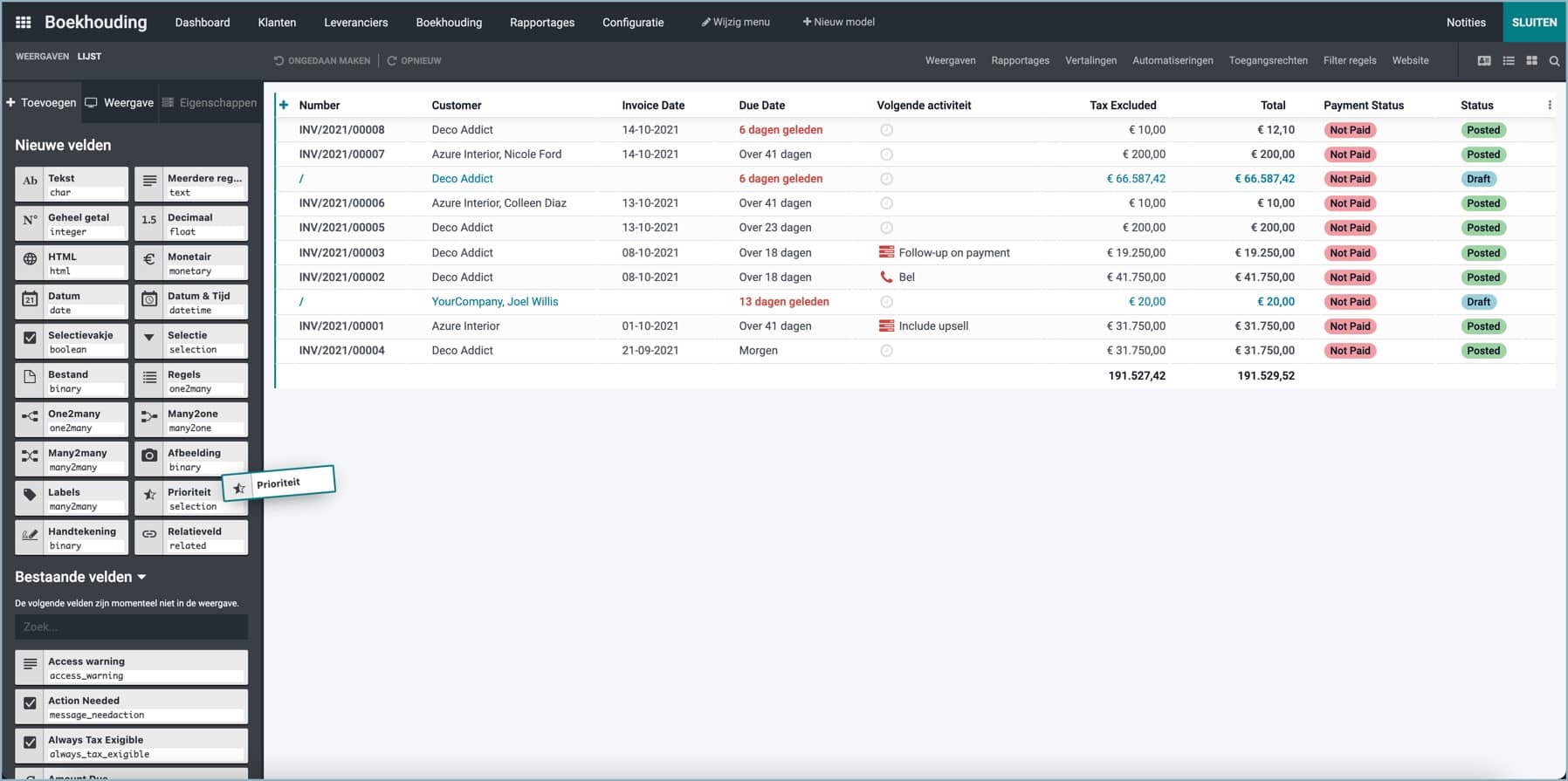
If you do not want to install a third-party app, Odoo Studio seems like an attractive alternative. With Studio, you can add fields, adjust screens, and make simple changes without having to develop a separate module right away.
For simple adjustments, that can work just fine. Think of an extra field, a custom view, or a simple change in a form.
But Odoo Studio is not a complete replacement for apps from the App Store or professional customization. As soon as you start building complex processes, relational fields, automatic calculations, or links between different components, the risk increases.
Studio customizations are stored in the database and not managed as clear source code. This makes it harder to see exactly what has been changed, how changes affect each other, and where a malfunction originates. Studio customizations can also cause issues during a future upgrade or with new custom work.
Also read our short blog about this Why is Odoo Studio not the holy grail?.
Studio can be handy, but it is not automatically the safe middle ground between standard Odoo and a third-party app.
An app is not a one-time investment
Customization and apps need to be maintained. This applies even when the app is offered cheaply or for free.
Odoo continues to develop. Standard functionality changes. Technical components are adjusted. With a new version, an app may no longer work properly or conflict with other parts of your database.
So you need to think ahead about the future. Who will ensure that the app is updated? How quickly does that happen? What does it cost if problems arise? And what happens if the developer stops providing support?
An app may seem like a cheap solution today, but in a few years it could become a blockage during an upgrade. Or you may be stuck with a supplier who no longer responds.
The purchase price therefore tells only a small part of the story.
Our preferred order
When the standard functionality of Odoo is not sufficient, we preferably follow a fixed order.
First, we check whether the process still makes sense and whether the standard functionality can be better utilized. Then we investigate together with the client and within our partner network which solutions already exist.
We look at, among other things:
functionality that is available as standard in Odoo;
a solution that is already known within the partner network;
a suitable module from the Odoo Community Association;
a commercial third-party app from a reliable developer;
specific development when no suitable solution exists.
An app from the Odoo App Store is therefore not automatically excluded. It is just not our starting point.
If there is nothing useful available, specific development may be a better choice. Sometimes we also try to make such a solution generic, so that multiple companies can benefit from it.
At Odoo customization we first check whether standard Odoo, configuration, or an existing solution can solve the problem. Only then does targeted development come into play.
When can a third-party app be justified?
There are good apps and reliable developers. So we do not say that every app from the Odoo App Store is bad.
A third-party app can be justified when:
the developer has a good reputation;
the functionality has existed for a long time;
the app for multiple Odoo versions is well maintained;
there is clear documentation available;
the developer is reachable;
problems are taken seriously;
the developer is willing to collaborate with your Odoo partner;
the app can be thoroughly tested first;
it is clear who is responsible for maintenance and support.
We also look at whether the app specifically solves one problem or adds a huge amount of functionality that you don't need at all.
A good app is not necessarily the app with the most features. Often, a smaller, well-maintained solution is wiser.
Discuss an app first with your Odoo partner
An Odoo database is not a collection of separate apps. The components influence each other. A change in inventory can have consequences for accounting. An adjustment in sales can affect invoicing. A new module can conflict with existing customizations.
Therefore, we advise against purchasing an app independently and then asking your Odoo partner if it can be installed and maintained.
First, discuss what exactly you want to solve. Look together at the process, the standard options, existing solutions, and the implications for management and upgrades.
A long-term relationship with a partner offers more certainty in practice than a one-off purchase from an unknown developer. You know who you are consulting, who knows your setup, and who is looking for a solution together with you.
That starts with a good Odoo implementation, where processes, responsibilities, and future support are discussed in advance.
Conclusion
An app from the Odoo App Store can sometimes be a good solution. But availability, an attractive screenshot, and a low price are not proof of quality.
You add the app to the business software your organization relies on. If the app does not work well, is poorly maintained, or conflicts with other components, you will notice that not only on a screen. It can have consequences for your processes, administration, and daily operations.
Therefore, treat a third-party app as a serious software choice. Research the creator, the quality, the maintenance, and the support. First, look at the process and the standard capabilities of Odoo. Then discuss with your partner which solution fits best.
Because in the end, you are not just buying functionality.
You are also buying a dependency.