
An ERP implementation requires more time and energy than just that of the implementation partner.
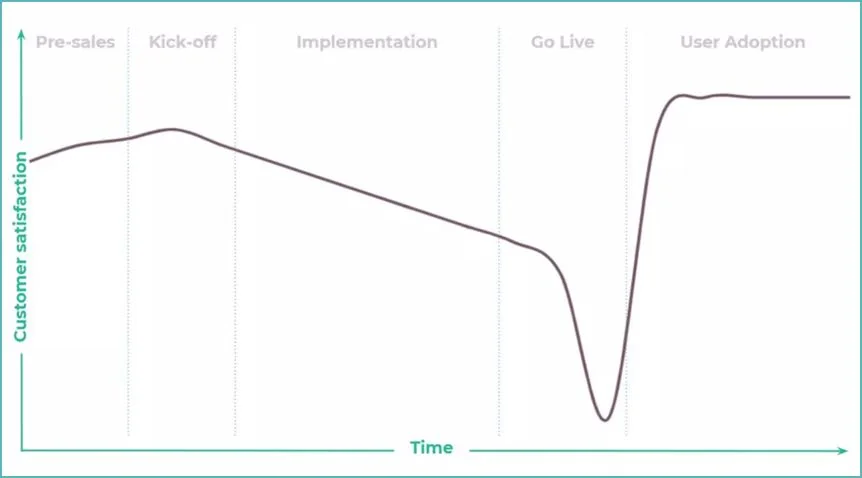
An ERP project often starts with enthusiasm. A new system is coming that should better support processes and provide the company with more insight. But as soon as the project work begins, the mood changes. Employees need to prepare processes, make choices, undergo training, and test. Meanwhile, regular work continues. That's where the tension lies: the project demands extra effort, while the daily operation does not take a break. Towards the go-live, that pressure often increases. Only after a few months do people experience how the new way of working can improve their work.
Why does an ERP project proceed emotionally differently than planned?
At the beginning of an ERP project, people mainly look ahead. They see opportunities: less duplicate work, better information, and processes that align better with each other. Those expectations are understandable. Often, there has been thinking about a new system for a long time. The choice has been made, and everyone is eager to start.
Then it turns out that an implementation does not primarily consist of installing software. Processes need to be discussed, data needs to be checked, choices need to be made, and agreements need to be documented. Employees must think about questions they may never explicitly consider in their daily work. Who is allowed to modify an order? What happens if a delivery arrives partially? What information should be included in a report?
These are not technical details that can simply be passed on to the implementation partner. The people in the company know the daily practice. Their input is necessary to ensure that the setup aligns well with the work. At the same time, they must continue to perform their regular tasks.
The mood can therefore change with each phase. Enthusiasm gives way to doubt or frustration, especially when the scope of the work becomes clear. Later, trust can be restored, for example, when employees see the new processes working in practice. This curve does not follow the same pattern in every company. It is not a fixed step-by-step plan that every ERP project must go through. However, we do see in projects that the available time and the involvement of the team strongly determine how heavy the different phases feel.
What happens if the project team does not get any time?
The daily operation does not stop because an ERP project is underway. Customers place orders, goods need to be received and delivered, questions need to be answered, and the administration continues. Project work is added on top of that.
This is often underestimated. Not only does the preparation take time. The elaboration of processes, the assessment of proposals, the training, and the validation of delivered work also require attention. And precisely the people who will have to work with the system must participate in discussions and testing. They are not spectators in the implementation; they know what is needed in practice.
If that time is not made available, people will look for the quickest way. They take less time to properly elaborate a question, postpone testing, or conclude a meeting with an agreement because there is already other work waiting. Sometimes an employee also thinks: the implementation partner knows what is wise. That assumption can lead to a choice being approved without anyone truly supporting it or fully understanding the consequences.
The project then seems to progress for a while. Until the setup is tested and it becomes clear what the decision means in daily work. Then the team has to revert to a choice that had already been finalized earlier. Sometimes adjustment is simple. Sometimes a decision affects multiple processes or brings additional work with it.
Time pressure is therefore not just a matter of planning. It affects the quality of decisions. An ERP project team needs time to gather information, discuss questions, and let choices sink in. A plan that does not include that time is not an efficient plan. It pushes the work to later, when the capacity is usually even smaller.
Why does the impact of choices often only emerge during testing?
A choice may seem logical on paper. Only in a practical situation do you realize if it actually works. That is why testing is an important part of an ERP implementation. You do not only check if a screen opens or an order is saved. You go through recognizable situations: a customer orders an item that is not in stock, a supplier delivers part of the order, or an employee needs to make a correction.
During such a test, it sometimes turns out that a decision has different outcomes than the team thought. A process may require more actions than expected. Information that someone needs is not in the right place. Or an exception that seemed small in the discussion occurs more frequently in daily practice than anticipated.
That moment can create tension. The team has to return to a choice that has already taken time. People may feel like they are starting over or that previous discussions were in vain. Yet this is exactly why you test: not to prove that every decision was immediately correct, but to discover whether the setup does what the company needs.
Testing and validating do require serious commitment from employees. If findings are left unaddressed, the work piles up. Then, just before going live, a long list of questions and adjustments arises that still need to be discussed or retested. In our blog about the biggest project risks we describe why validation and clear responsibility play such a significant role.
A good testing phase therefore requires more than a test environment and a checklist. You need people who have time to go through realistic scenarios, discuss findings, and reassess the results. That is work. It is part of the implementation.
Why is the tension rising towards go-live?
A lot is at stake for the go-live. A lot of time has been invested and the team has made a series of decisions. The organization expects that the new system will support the work. The go-live feels like the moment when all that effort should start to pay off.
That is exciting. People want to know if the data is correct, if the processes work, and if everyone is ready to work in the new system. There are often still open points. At the same time, the team is tired. The regular tasks have not disappeared, and the implementation has required extra attention for months. Even when the project is well prepared, the final phase can feel heavy.
That tension does not automatically mean that the project is going wrong. An ERP implementation changes the way people do their work. You can prepare a lot in advance, but only when employees work with real orders, deliveries, and questions does it become clear how the new way of working feels in practice.
That calls for realistic expectations. A go-live is not a magical moment when every process runs smoothly from day one. It is an important transition. The team must be available to catch questions, assess problems, and adjust where necessary. That again requires time and attention.
An organization may temporarily perform less around the go-live. That is difficult, especially when customers and suppliers just keep going. Still, you need to take this into account in the planning. If you expect everyone to complete the project without the daily operation noticing anything, you put pressure on the people who have to keep both sides running.
When will the new way of working become familiar?
After the go-live, employees need time to build routine. The first weeks are often focused on questions, checks, and solving problems that only become visible with daily use. This is part of the transition to a new way of working.
After a few months, the team's experience often changes as well. People know better where to find information, which steps to follow, and how processes connect with each other. They begin to recognize the benefits. Employees who became fatigued during the project can then bounce back. They notice, for example, that information no longer needs to be maintained in different places or that a process requires less manual work.
This shift does not happen automatically on the day the project is formally completed. Training, guidance, and support after go-live remain important. Employees need space to ask questions and discuss uncertainties. A system can work technically well while people still do not have enough confidence to work with it independently.
Therefore, it is wise not only to look at the date when the software goes live. Also consider the period afterward: when can the team work independently, what guidance is needed, and how is it monitored whether processes are running well in practice? The approach for ERP implementation should also take that transition into account.
How do you keep the curve manageable?
You cannot plan away the emotional curve. An ERP implementation requires change, and people respond differently to that. However, you can prevent unnecessary pressure from building up.
Start by making the required time visible. Map not only the meeting hours but also the time for preparation, elaboration, training, testing, and validation. Discuss with managers which tasks will be temporarily taken over, postponed, or redistributed. If employees have to add their project tasks continuously, that is a choice of the organization. Make that choice explicit.
Also plan space for decision-making. Not every topic needs to take a long time, but people must understand what they are agreeing to. If someone does not have time to properly assess a proposal during a meeting, agree on when that will happen. A quick confirmation is not always a supported decision.
Make the testing phase concrete. Work with recognizable situations from daily practice and designate who will execute them and who will evaluate the outcome. This way, you prevent testing from becoming a general task that everyone assumes someone else will pick up.
And be honest about the impact on daily operations. A company may temporarily accomplish less work during an ERP implementation. That is not a sign of failure. It is a result of the time people invest in a change that should improve the work afterward. It is necessary to consciously plan that period so that the pressure does not become visible only when the team is already nearing its end.
The main lesson is simple: an ERP implementation is also a project of people and their time. The software can do a lot, but it does not take over the preparation, choices, training, and testing from the team. Those who make room for this give people the chance to make better decisions and work towards going live with more confidence.
The curve is part of the change. The organization partly determines how steep it becomes.